

From survival to serenity: Building a foundation of trust, healing, and hope.
Let’s be real for a second: parenting a teenage girl in today’s world is a bit like trying to solve a Rubik’s Cube while riding a unicycle. It’s loud, it’s fast, and sometimes, it feels like everything is just a little bit out of control. But when your daughter is struggling with deep-seated anxiety, depression, or the aftermath of a difficult experience, that "normal" teenage chaos turns into something much heavier. It feels less like a phase and more like a storm that won’t let up.
If you’ve been looking into a youth residential treatment center or searching for a behavioral health residential program, you’ve probably seen the term "trauma-informed care" tossed around like confetti. It sounds great, right? Very professional. Very "medical." But what does it actually mean for your girl?
At Compassion Care Group, we believe that understanding the "why" behind the "what" is the only way to help a young woman truly find her way back to herself. This isn’t just about rules and schedules; it’s about a fundamental shift in perspective that changes everything.
Welcome to part three of our series on teenage girls' recovery. Today, we’re diving deep into why trauma informed residential care isn’t just a buzzword, it’s the game-changer your daughter deserves.
The "Aha!" Moment: Shifting the Question
In traditional settings, when a teen girl acts out, shuts down, or struggles with intense emotions, the first question people often ask is, "What is wrong with her?" It’s a question that leads to labels, punishments, and a whole lot of shame.
Trauma-informed care flips the script. Instead of asking what’s wrong, we ask, "What happened to you?"
This shift is revolutionary. It acknowledges that her behaviors, whether it’s the mountain-high walls of teen anxiety or the deep valleys of teen depression, aren't just "bad behavior." They are survival strategies. They are her brain’s way of trying to protect her from a world that once felt unsafe. When we stop looking at her as a problem to be solved and start seeing her as a person who is trying to heal, the whole atmosphere changes.

Safety: The Essential Foundation for Healing
Think of your daughter’s nervous system like a high-tech security system. For many girls entering residential treatment for teens, that security system has been stuck on "High Alert" for a long time. When her brain thinks it’s in a constant state of emergency, it’s impossible to focus on school, hobbies, or even basic conversation.
A high-quality teen residential treatment center knows that you can’t talk someone out of a survival state. You have to show their body that they are safe.
Physical vs. Emotional Safety
Most places can provide physical safety (locked doors, supervised grounds). But trauma-informed care goes a step further by prioritizing emotional safety. This looks like:
- Predictability: Knowing exactly what the day looks like helps calm a chaotic mind.
- Consistency: Staff who are calm, steady, and nurturing, even when things get rocky.
- Environment: Creating spaces that feel like a home, filled with warmth and light, rather than a sterile clinic.
When she finally feels that it’s okay to let her guard down, her nervous system can settle. And once she’s out of "survival mode," she can finally enter "healing mode."
Giving Her the Reins: The Power of Agency
Trauma, by its very nature, is an experience where a person loses control. Whether it was a single event or a long-term situation, that feeling of powerlessness can stick with a girl for years.
One of the most beautiful aspects of trauma informed residential care is how it restores that sense of agency. In a traditional program, everything is "done to" the resident. In our world, it’s "done with" her.
We provide choices. We give her a seat at the table when discussing her treatment plan. If she’s feeling overwhelmed in a session, she’s taught how to advocate for a break. By giving her a say in her recovery, we’re helping her rebuild her self-worth and confidence. She isn't just a patient; she is the lead architect of her own brighter future.

Deciphering the Code: Behavior as Communication
We’ve all been there: the door slams, the "I hate it here" is yelled, or the silence becomes deafening. It’s easy to meet that with frustration. But in a mental health residential treatment for adolescents that uses trauma-informed principles, we see those moments as a code.
If your daughter is struggling with residential treatment for teen anxiety, her "defiance" might actually be a panic attack in disguise. If she’s dealing with depression, her "laziness" might actually be her brain being too exhausted to function.
Instead of meeting a "rule-break" with a cold punishment, our team uses it as a learning opportunity. We ask:
- What was the trigger?
- How did your body feel in that moment?
- How can we handle this differently next time?
This approach removes the layer of shame that so often keeps girls stuck in a cycle of self-sabotage. If you're wondering if your daughter's current struggles are just a phase or something more, you might find our guide on 5 signs your teen needs a residential treatment center helpful.
The Science of Resilience
While the heart of our work is nurturing and loving, it’s also grounded in cold, hard science. Research shows that girls in trauma-informed environments:
- Engage deeper: They stay in treatment longer and participate more fully because they don't feel judged.
- Build stronger connections: They learn how to form healthy, safe relationships with peers and mentors.
- Experience fewer relapses: Because they are learning to manage the root cause (the trauma) rather than just the symptoms (the behavior).
We utilize evidence-based therapies like Dialectical Behavior Therapy (DBT) and Cognitive Behavioral Therapy (CBT), but we weave them into a holistic, trauma-sensitive blanket. It’s about more than just checking boxes; it’s about fostering resilience, heart, and holistic well-being.
Why a Therapeutic Group Home Might Be the Key
Sometimes, a large hospital-like setting can feel too overwhelming for a girl who is already feeling fragile. This is where a therapeutic group home for teens can be a literal lifesaver.
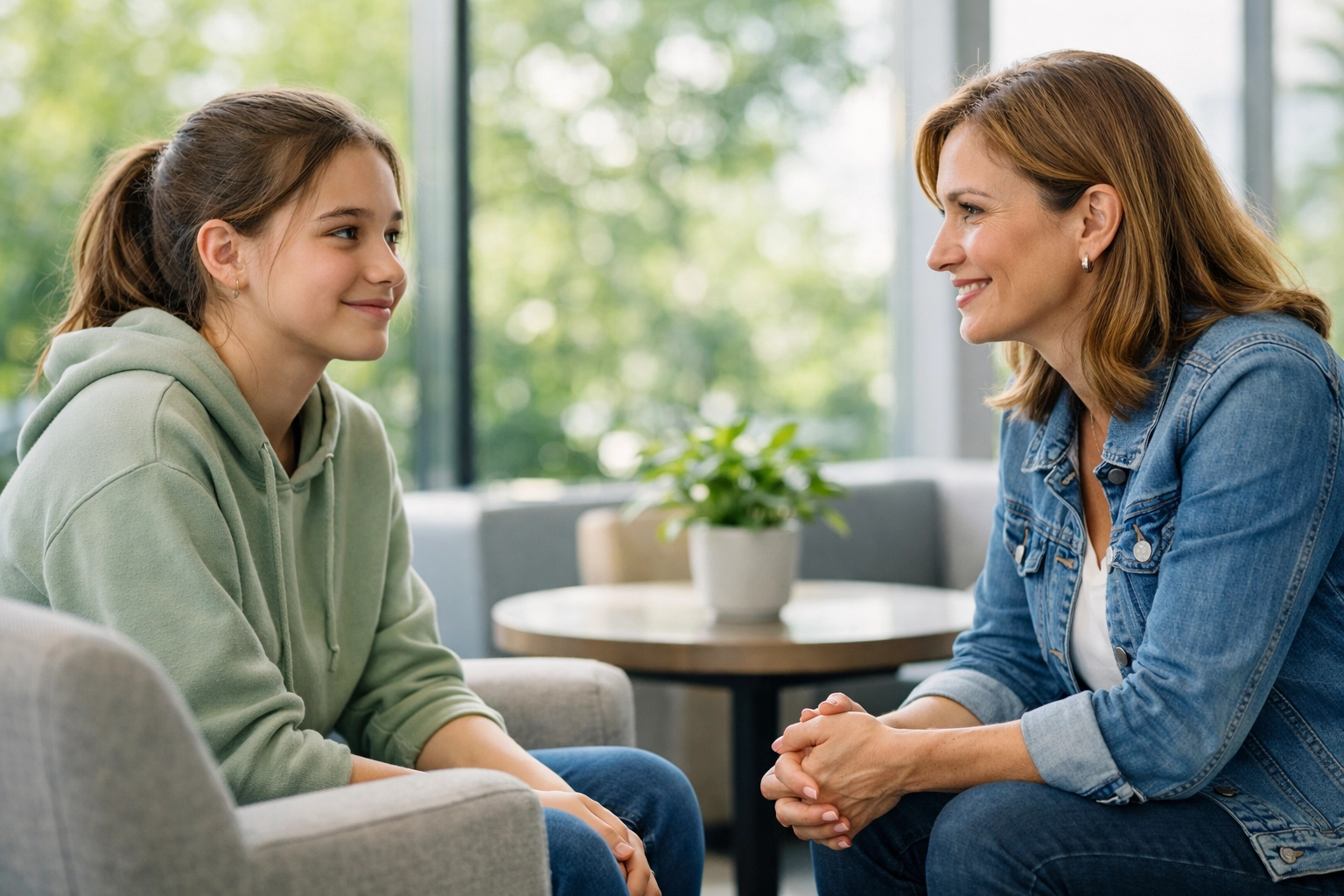
By keeping the environment small and "homey," we can offer the high level of clinical care found in a youth residential treatment center while maintaining the warmth and intimacy of a family setting. It allows for more individual attention, more encouragement, and a place where she can truly feel she belongs.
If you’re currently trying to navigate the overwhelming world of options, check out our post on how to choose a teen residential treatment center for a roadmap through the process.
Walking the Path Together
As a parent, your heart is probably heavy right now. You want your daughter to find her spark again, but the path forward can look dark and winding.
Please know this: your daughter is not "broken." She is resilient. She is strong. She has just been through a lot, and her brain is doing its best to cope. Trauma informed residential care is the light that helps her see the path back to her true self.
At Compassion Care Group, we don’t just provide a bed and a schedule. We provide a sanctuary. We provide a place where "What happened to you?" is met with "We’re here for you."
If you’re ready to learn more about how we help girls overcome these hurdles, take a look at our deep dive into residential treatment for teen depression.

Choosing the right care for your girl is the bravest thing you’ll ever do. It’s a journey of self-discovery and personal growth: not just for her, but for your whole family. Let’s walk it together. We are here to offer the support, expertise, and love your daughter needs to build a foundation for a brighter future.
Stay tuned for our next post in the series, where we’ll talk specifically about the "Parent's Roadmap" and how to navigate the logistical side of choosing the right center without losing your mind!
Remember: there is hope, there is help, and there is a version of your daughter waiting to bloom again. Let’s help her find it.