

If you’re reading this, chances are you’re exhausted. You’ve probably spent late nights scrolling through forums, dozens of hours in waiting rooms, and maybe even a few tearful conversations with school counselors. You love your daughter fiercely, but lately, it feels like you’re losing her to a version of herself you don’t recognize. Whether it’s sudden outbursts, deep withdrawal, or the heavy weight of anxiety, you know something deep is going on.
You’ve likely heard the term trauma informed residential care tossed around by professionals. It sounds a bit clinical, doesn't it? A bit "medical textbook." But here at Compassion Care Group, we like to break things down into plain English. In reality, trauma-informed care is the most loving, nurturing, and scientifically grounded way to help your daughter find her smile again.
Let’s talk about why this approach isn't just a "treatment option", it’s the absolute game-changer your family has been looking for.
The Shift from "What’s Wrong?" to "What Happened?"
For a long time, traditional mental health care focused on "fixing" behaviors. If a girl was acting out, the goal was to stop the acting out. If she was skipping school, the goal was to get her back in the seat. But trauma-informed care flips the script. Instead of asking, "What is wrong with this girl?" we ask, "What happened to her?"
Even if there wasn't one single "Big T" trauma (like a major accident or loss), many teenage girls experience "Little t" traumas, bullying, social isolation, or overwhelming academic pressure, that keep their nervous systems in a constant state of "fight or flight." When a girl is in survival mode, she can’t learn, she can’t connect, and she certainly can’t heal.
By choosing a youth residential treatment center that prioritizes this shift, you’re giving your daughter permission to stop being the "problem" and start being a person who deserves to be understood.

A teenage girl sitting peacefully in a garden, reflecting the calm environment of a residential program.
Why Residential Treatment for Teens is the "Reset Button"
You might be wondering, “Can’t we just do this with weekly therapy?” Sometimes, yes. But when a girl is caught in a cycle of trauma, her home and school environments, no matter how loving they are, can be full of "triggers." A certain song, a specific hallway at school, or even a well-meaning comment from a sibling can send her spiraling back into a panic.
A residential treatment for teens program acts like a giant "pause" button on the world. It provides:
- A Safe Learning Environment: We provide a safe learning environment where she can keep up with her life without the crushing pressure of social hierarchies.
- 24/7 Emotional Support: Trauma doesn’t keep 9-to-5 office hours. When she has a flashback or a breakdown at 2:00 AM, our loving, dedicated caregivers are right there to help her regulate her emotions in real-time.
- A Community of Peers: There is an incredible power in realizing, "I am not the only one." In a therapeutic group home for teens, she’ll find other girls who truly get it.
The Science of the "Flipped Lid"
Let’s get a little nerdy for a second (but stay with me!). In trauma-informed care, we talk a lot about the brain. When a girl is traumatized, her "downstairs brain" (the part that controls survival) takes over, and her "upstairs brain" (the part that does the logic and decision-making) effectively "flips its lid."
You can’t reason with a flipped lid. You can’t "consequence" a flipped lid into behaving. The only way to bring that lid back down is through felt safety, warmth, and nurturing.
Our philosophy at Compassion Care Group is centered on creating a compassionate, therapeutic environment. We focus on calming the nervous system first. Once she feels safe in her body, she can begin to engage in evidence-based therapies like CBT, DBT, or EMDR. This is why trauma informed residential care is so effective, it prepares the soil before trying to plant the seeds of recovery.

Two teenage girls laughing together during an art therapy session, showing the power of peer connection.
More Than Just a Program: It’s a Path to Resilience
We aren't just looking for a quick fix. We want to build a foundation for a brighter future. When your daughter enters a behavioral health residential program, she isn't just "going away" to get better. She is embarking on a journey of self-discovery.
Through our service delivery model, we emphasize empowerment. She learns how to:
- Identify her triggers before they become explosions.
- Advocate for her own needs with confidence.
- Build healthy, boundaried relationships with her family and friends.
As our CEO, Angela Allen, always says, "Healing isn't a destination; it's a way of moving through the world with more grace and less fear." We believe every girl has a wellspring of resilience inside her, sometimes it just gets buried under the weight of the world.
How to Know if This is the Right Step
Deciding to look for a teen residential treatment center is one of the hardest decisions a parent can make. You might feel guilty, or like you’ve failed. Let’s clear that up right now: seeking a higher level of care is an act of profound love. It’s saying, "I love you enough to get you the expert help I can’t provide at the kitchen table."
If your daughter is struggling with:
- Severe anxiety that prevents her from attending school.
- Depression that makes her feel "numb" or "empty."
- Unresolved trauma that leads to self-harming behaviors.
- A total breakdown in communication at home.
…then a mental health residential treatment for adolescents might be exactly what she needs to find her way back to herself.

A teenage girl looking out a window at a bright, sunny landscape, symbolizing hope and a new beginning.
What to Look for in a Center
Not all centers are created equal. When you are researching, look for these "green flags":
- A Focus on the Whole Person: Do they address physical health, education, and family dynamics alongside mental health?
- Transparency: Are they open about their principles and how they handle difficult moments?
- A "Home" Feel: Does the facility feel like a hospital or a home? A therapeutic group home for teens should feel warm, inviting, and safe.
- Qualified Leadership: Take a look at who is running the ship. Our leadership team is dedicated to the highest standards of care. You can meet our leadership here.
Let’s Walk This Path Together
If your heart is telling you that it’s time for a change, please know that you don't have to navigate this alone. The road to healing can be long and winding, but it’s a lot easier when you have a team of experts walking beside you with attention, encouragement, and holistic well-being.
At Compassion Care Group, we specialize in turning "I can't do this anymore" into "Look how far I've come." Your daughter’s story isn't over: it’s just starting a new, more hopeful chapter.
Are you ready to see how trauma informed residential care can change your daughter's life? Whether you have questions about our provider service plan or just need a friendly voice to talk to, we are here for you.
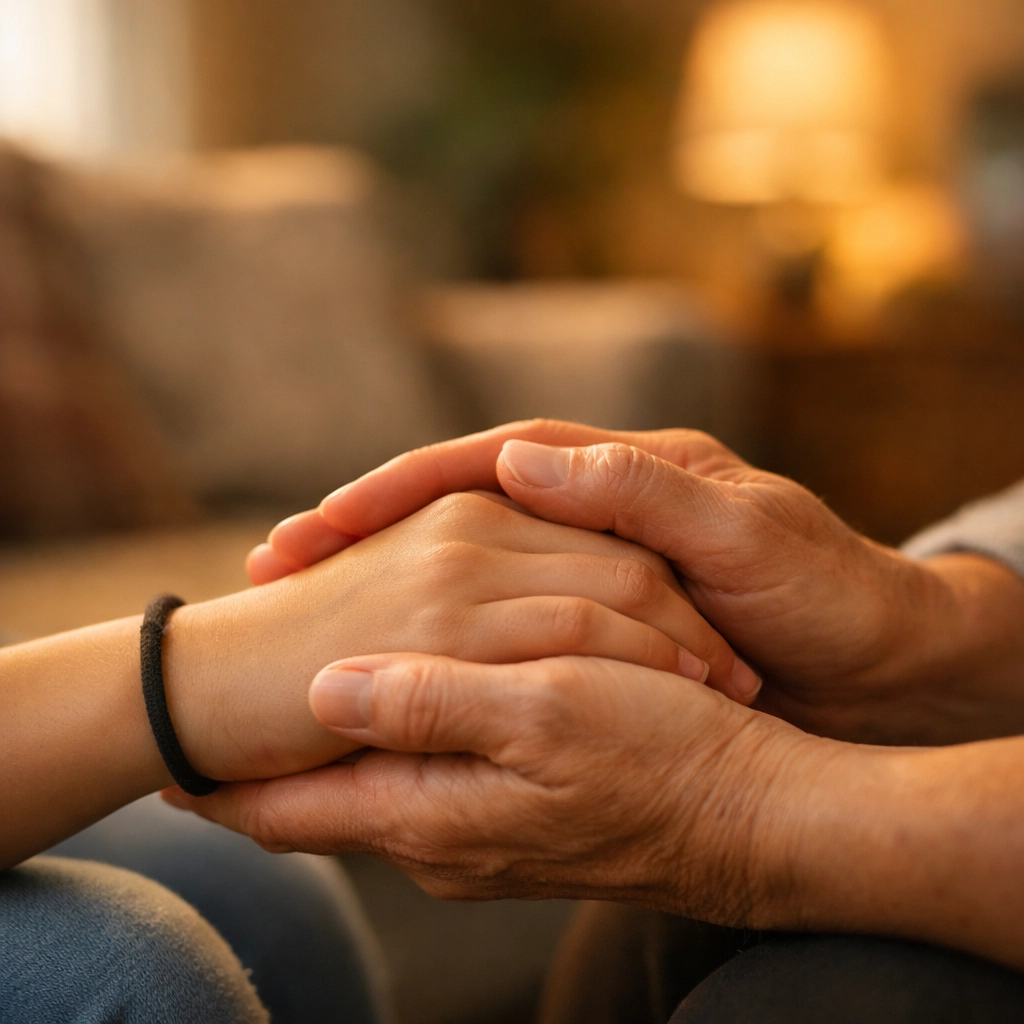
A close-up of two people holding hands, representing the partnership between parents and caregivers.
Take the first step today:
- Set an appointment to speak with our team.
- Send your referrals if you’re a professional looking to help a family.
- Or simply contact us to learn more about how we can help your daughter find her light again.
You’ve got this, and we’ve got her. Let’s get started.